A paid engagement · 10 working days · Fee credited against the build

Find out what's actually broken before you fund the fix.

Two of our engineers spend ten working days inside your operation. You leave with five written documents: what is failing, what it costs you every month, what to build, and an explicit list of what not to.

₦3,500,000, credited in full against the build
if you proceed within 60 days.

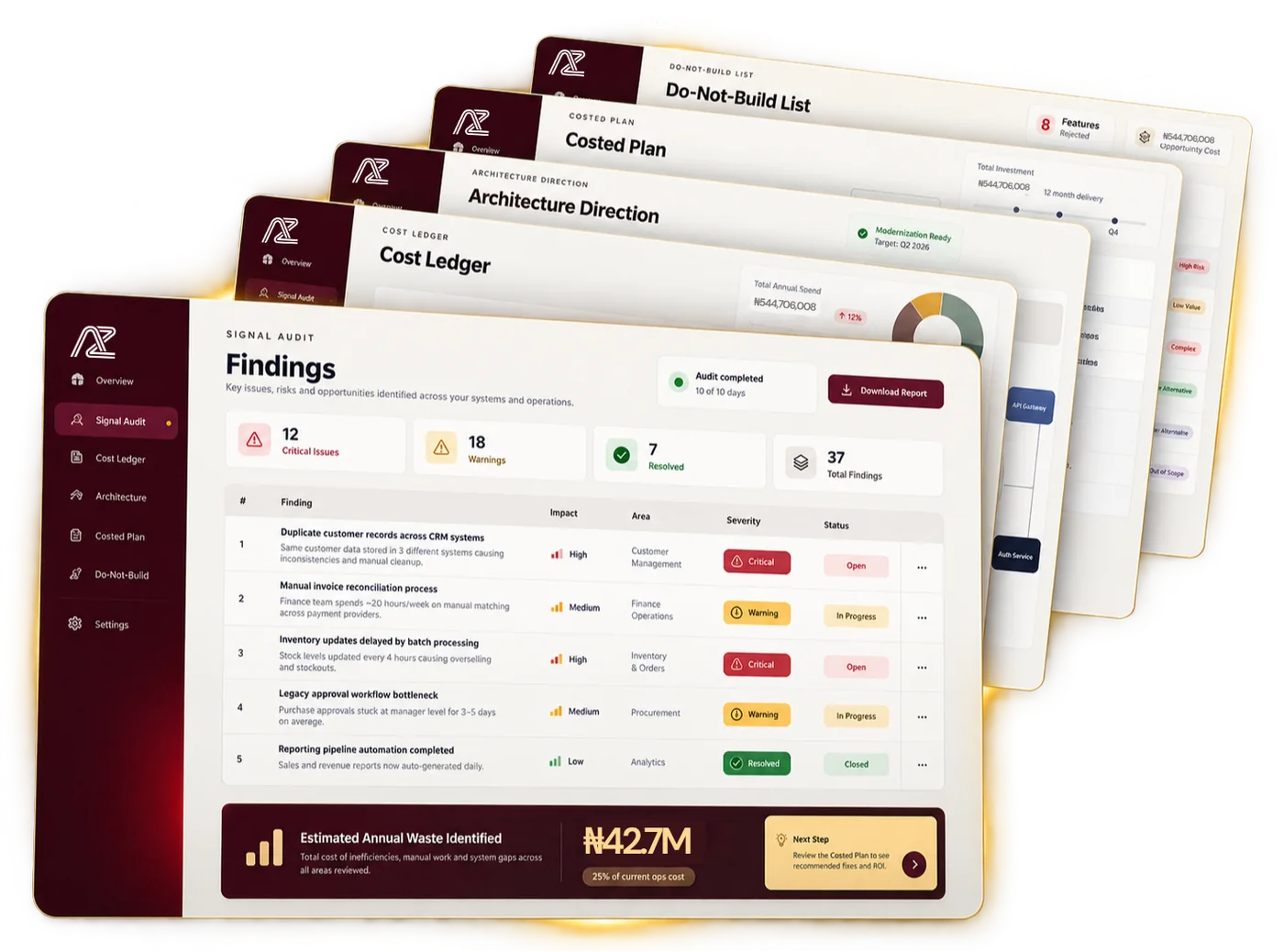
The five Signal Audit documents, front page showing findings by severity

We would rather disqualify you now than in month five.

This engagement is narrow on purpose. Two columns, and the right-hand one is not a soft no.

Book it if

  • You have a system that has to work, and a reason it currently doesn't.
  • Someone in your organisation is manually moving information between two systems every morning.
  • A previous build did not land, and nobody has written down why.
  • You are about to sign a proposal and you cannot tell whether the scope is right.
  • The failure has a number attached to it, even if nobody has calculated that number yet.

Don't book it if

  • You want a website, a brochure app, or a landing page.
  • You already know exactly what to build and you want it quoted.
  • The decision-maker will not be in the room for any of the ten days.
  • You need the answer this week.

If you're in the right-hand column, say so in the form and we'll tell you who to call instead. That reply is free.

Ten working days. Here is every one of them.

No discovery phase that quietly becomes a proposal. This is what happens, in order.

Days 1–2

Access and inventory

We sit with the people who do the work, not the people who describe it. Every system, every spreadsheet, every WhatsApp group that carries an operational message gets written down, including the ones nobody mentions in the workshop because they're embarrassing.


Days 3–6

The exceptions

The happy path is not where systems fail. We go looking for the duplicate submission, the approver on leave, the record that arrives out of order, and the reconciliation someone does by eye on a Friday. This is where the money is, and it is the part a proposal-writing vendor will never do for free.

Days 7–8

The number

We put a cost on each failure. Hours, rework, penalties, lost revenue, the customer who didn't come back. Some of these will be estimates and we will label them as estimates. You end up with a ranked list where the top item is the one worth paying to fix and the bottom three are not.

Days 9–10

The direction

Architecture direction with the trade-off attached to every decision, a costed build plan with sequence, and the list of what we recommend you do not build. Presented in person to whoever signs.

Five documents. All of them yours, whether or not you build with us.

Written for an engineer who has never met us.

01

The Problem Statement

What is failing, where, and to whom, in language your board can read and your engineers can act on.

Replaces: the six-week internal argument about what the project actually is.

02

The Cost Ledger

Every failure with a monthly figure against it, ranked. Estimates labelled as estimates.

Replaces: a business case written from assumption.

03

The Architecture Direction

Where data lives, who may hold it, what happens when a dependency is down, which system is right when two disagree. Each decision paired with what it costs.

Replaces: the architecture that gets decided by accident in week two of a build.

04

The Costed Plan

Scope, sequence, and a price. Broken into slices that each reach production, so you can stop after any one of them.

Replaces: the fixed-price proposal you cannot evaluate.

05

The Do-Not-Build List

What we recommend you don't build, and why. Usually the most valuable page in the pack.

Replaces: eighteen months of building the wrong thing well.

These are yours on delivery. Not a sales deck, not conditional on signing anything. Take them to another firm if you want to. Several clients should.

₦3,500,000

Two engineers, ten working days, on site and in your systems. One fixed fee, invoiced on start.

If you commission a build with us within 60 days, the full ₦3,500,000 is credited against it. Not a discount, not a voucher. The same money, moved.

For context: the failures this engagement is designed to find are the ones that usually cost more per quarter than the audit costs once. And a build scoped from the wrong problem statement does not cost you the audit fee. It costs you the build.

Engagements outside Nigeria are priced at $2,500, invoiced in USD.

Book the audit
The Nothing New Guarantee

If the audit does not surface at least one failure your team had not already documented, you don't pay.

Not a partial refund and not a credit. We invoice on start; if we get to day ten and everything we found was already written down somewhere in your organisation, we cancel the invoice.

We have one condition and it is the obvious one: we need access to the people who do the work. If we get the workshop version instead, we can't find the exceptions, and neither can anybody else.

The three things people ask before booking.

"Why wouldn't we just start building?"

You can. Every decision in the first two weeks of a build is structural: where data lives, who holds it, what happens when a dependency is down. Made deliberately, they're cheap. Made by accident under delivery pressure, each one is a rewrite. This engagement is those decisions made deliberately, before anyone is committed to a deadline.

"Can't you do this in a free meeting?"

A free meeting produces a proposal. A proposal is written to be signed, which means it's written from the happy path you described. The exceptions, the ones that decide whether the system works, take ten days to find and nobody finds them for free. That's the honest reason this is paid.

"What if we don't build with you afterwards?"

Then you keep five documents you can hand to any firm, and we've been paid for the work. That is a fine outcome and it happens. It's also why the deliverables are written for an engineer who has never met us.

Who does it

The people below are the people who show up. Not a delivery manager, not a sales engineer.

Azubike Obi

Azubike Obi

Founder & CEO

[One line: background, and what they work on day to day.]

Nsofor Gerald

Nsofor Gerald

Chief Operating Officer

[One line: background, and what they work on day to day.]

Questions

How much of our team's time does this take?

Roughly two hours a day from the people who do the work, plus a half-day at the start and the presentation at the end. We work around shifts.

Do you sign an NDA?

Yes, before day one, and we'll sign yours rather than insist on ours.

Is this remote or on site?

On site for days 1–6 in Abuja and Lagos. Remote elsewhere, and we'll say honestly if we think remote will weaken the finding.

What if the answer is "don't build anything"?

Then that's the deliverable, and it's the cheapest report you will buy this year.

Can we do a shorter version?

No. Six days finds the happy path. Ten finds the exceptions. A shortened audit is a proposal with a fee attached.

Tell us what cannot go wrong.

An engineer reads it. We reply within one business day, and if we're the wrong people, that's what the reply will say.