Live telemetry
Site to office, buffered the moment the link drops rather than discarded.
Sector · Oil & Gas
An alert fires on site at 09:40. The town office hears about it at 10:20. We build the systems that close that gap, on connections that fail, because rig connections do.
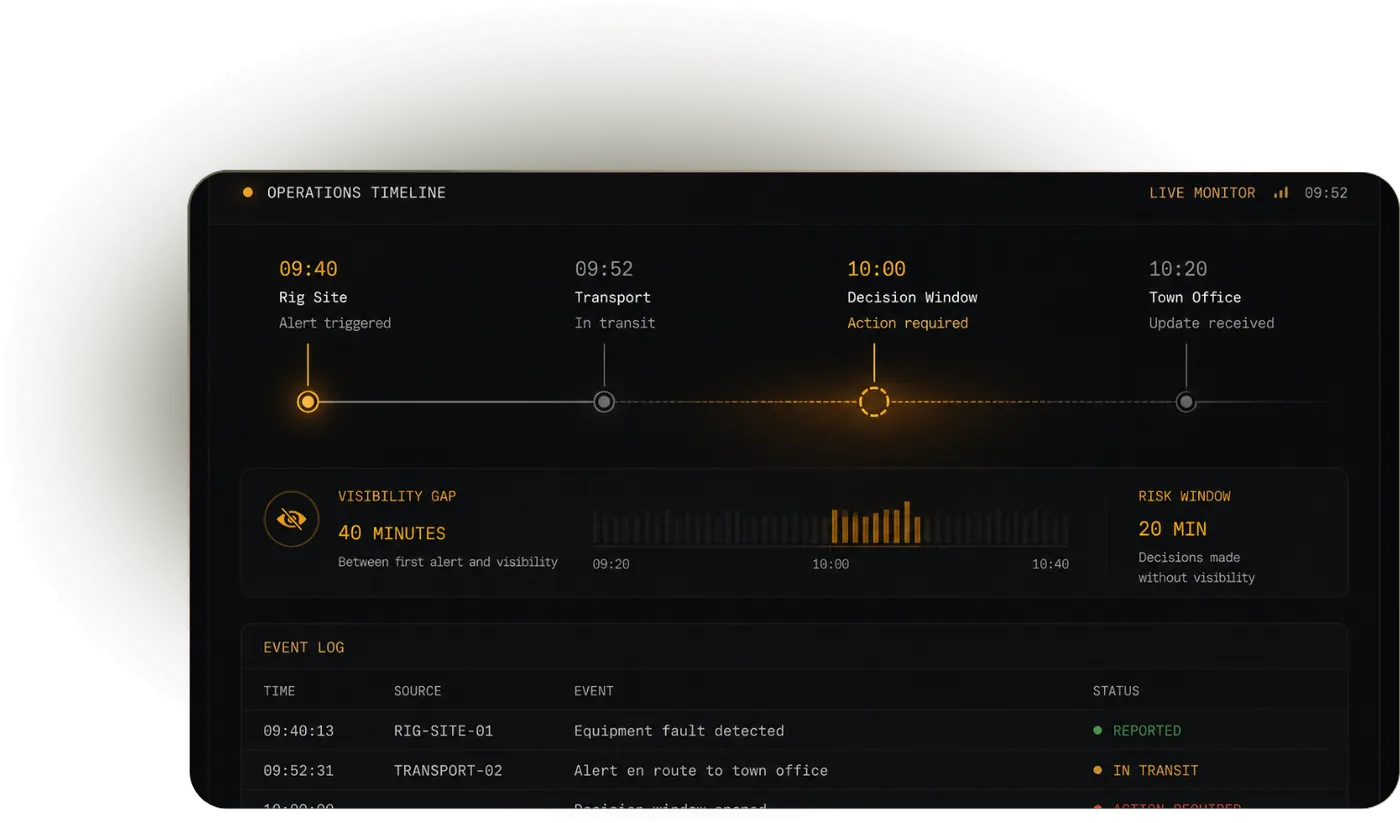
Every decision made in that window is made blind.
Not wrong, exactly. Made without the one fact that mattered. By the time the update arrives, someone has already committed the crew, the equipment or the spend, and the correction costs more than the original call.
Connectivity is the requirement, not the constraint.
Site to office, buffered the moment the link drops rather than discarded.
It catches up. Late is a state we handle; missing is not.
To the person who can act, not the person on the org chart.
Generated from what happened, not typed from memory at the end of a tour.
In the format your existing tooling already reads.
Same three stages as any engagement. The site visit is not optional here.
Stage one
Days on the rig, not in the office. The exceptions live where the work is.
Stage two
One data path, live, end to end, before anything else is built.
Stage three
Your team runs it. We are not a dependency on an offshore roster.
Buffered, transmitted late, flagged as late. Never gone. Most systems treat a dropped link as an error state. On a rig it is the normal state.
Everything we build assumes the connection will go, and is judged on what happens when it does. If a vendor cannot tell you what their system does at minute six of an outage, they have not thought about it.
If there is a gap between something happening on site and someone in the office knowing, that gap has a cost. We will find it.